Cloudlog Station Diary Hub
Welcome, this is a hub for public Cloudlog station diary posts, gathered in one timeline so you can easily see what other stations are sharing.
-
Apr 22 2026; SF=112, A=19, K=1
Pretty busy day, so didn't get much radio time until the sked with Roger GW5NF in the late afternoon. Good signals although the bands have been noisy today which of course was worse on phone than on CW.
The 19z CWT was better on 15m than I'd expected, given conditions through the day. Managed to work a few west coast North Americans including Jim K6AR on 15m and a couple of the other usual suspects. At the start, good signals from AA3B, N3RD and VE3EJ in quick QSOs before the contest started. 20m seemed poorer into North America than last week.
Justin G4TSH messaged to remind me of the 80m SSB session going on this evening, so popped on there once I'd had enough of the CWT and worked a handful of stations including Justin, Keith GW0ARK ,Roger G4BVY and Andy G4PIQ.
Some nice feedback from the talk last night. One of the guys had already got his Quansheng going on 2m FT8 and had a QSO with it. Fantastic!
-
Apr 21 2026; SF=105, A=24, K=2
Not a lot of time to look around the bands so far - Welsh lesson today and I've a VHF talk to give to the Yorkshire Mesh Radio Club tonight. I'm looking forward to that but haven't had a lot of time to prepare for it! So, there's been hasty updating of slides today when I've not been in Welsh.
-
DXChrono Desktop - Launched
After 2 months of development, I put DXChrono Desktop live and available for purchase today, which kicked my anxiety into high gear. But after some long testing with GM1TGY & GW4VXE, I felt it was ready for prime time, with landing pages built, Stripe set up as I decided to charge for it, and a custom-built licensing system on the work CRMs backend.
DXChrono Desktop brings all the features of the web version to the desktop, with better graphics, dx cluster, psk reporter integration, satellite tracking, and a ton more, all for a one-off fee of £15.00
If you're interested, you can find out more at https://desktop.dxchrono.com
-
Apr 20 206; SF=105, A=23, K=2 (and the 10m FT8 monitoring station)
The lack of 10m FT8 spots made me question whether the SDR/loop was working ok. It's perhaps worth explaining how this works. It's an indoor active loop given to me by John G8CQX. This goes into a SDRPlay RSP2Pro receiver running on an old laptop which, amongst other things, runs SparkSDR. SparkSDR is the nicest SDR program I know for decoding FT8 and FT4. It calls an instance of WSJT-X, so it decodes everything that WSJT-X would.
Anyhow, a quick test of the loop on 20m showed signals coming through and when I powered off the loop, the signals disappeared. So it's propagation rather than a problem - which I thought it probably was, but for so long, I have seen signals coming through on 10m FT8 regularly, it was unusual to see so little.
-
Apr 19 2026; SF=106, A=33, K=4
MM contest still going on this morning. I'd put the DX Commander back up this morning as the wind had really dropped over night. Tuned around 20m working a few stations that 'caught my ear'. Best DX was VK1A who sounded fluttery - not surrprising looking at the A and K this morning.
-
Apr 18 2026; SF=107, A=4, K=5 (World Amateur Radio Day)
Conditions seeming very poor on HF again today. The K up at 5 won't help.
Made a handful of QSOs in the CQMM contest around lunchtime; EK/DL2JRM was about the only signal I could hear (barely) on 15m at one point.
The latest in the '145 Alive' series took place around lunchtime. I worked MW7ABS/P on Foel Cwmcerwyn not far away. Could hear a couple of stations further north in Wales - around Pwllheli but didn't get involved in calling.
-
Apr 17 2026; SF=108, A=3, K=0 (and some CW glitches on the FTDX-10)
Every now and again, the dash paddle won't send on the FTDX-10. Until this morning, I assumed it was something to do with the paddle - a bit of dirt got in the contacts or something. It happened mid QSO this morning leaving me sounding like I couldn't send! Played around a bit and couldn't see any dirt in the contacts. But it was odd, it felt like I was getting a bit of a dash and then it was stopping. Decided to switch off the radio and switch it on and - sure enough, back to normal. So it seems like a software glitch. I can see some reference to similar issues on the web.
There's a similar issue on the receiver of the FTDX-10. Once in a while, signals on the receiver suddenly sound all raspy. When it first happened, I thought oh no, what's happened. Turned the radio off and back on again and it was fine. Subsequently, I've found that all you have to do is to go to transmit and back again and signals will sound normal again.
I'm still very fond of the FTDX-10 - these issues only happen once every few weeks and as soon as you recognise them, it's easy to deal with.
-
RSGB FT4 Activity Day
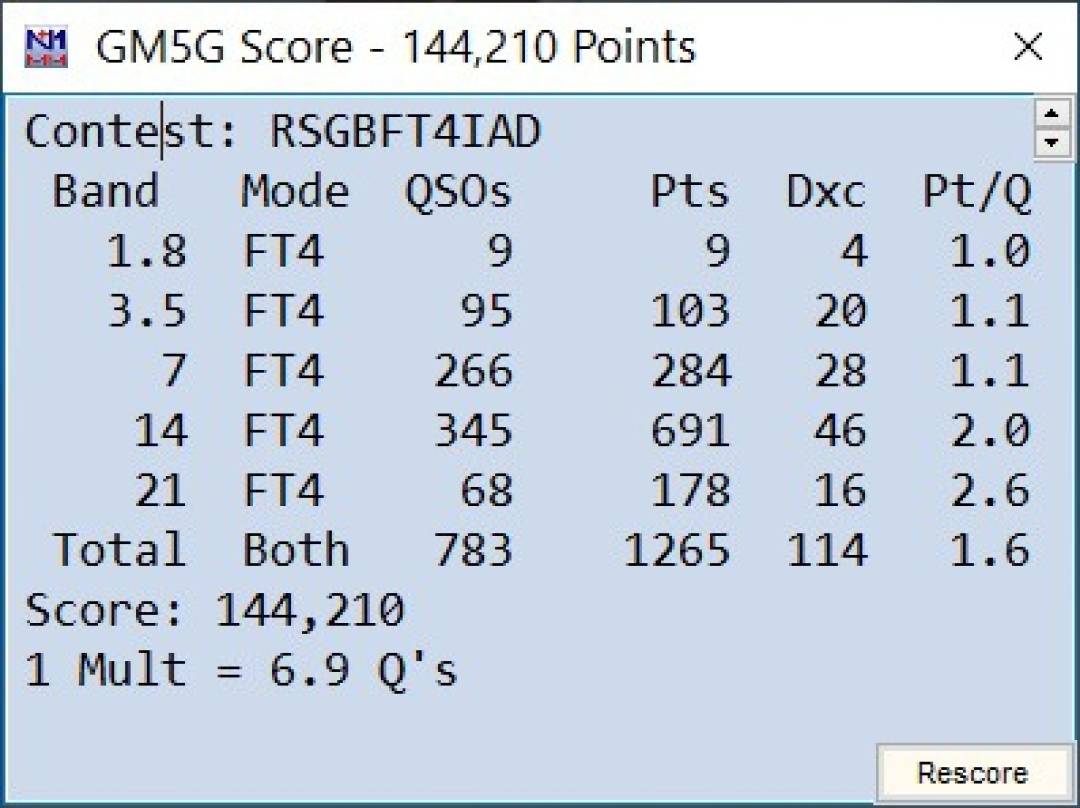
QSO Summary
Last weekend was the RSGB FT4 Activity Day Contest (it ran over two days). This year, GM1TGY, as GM5G, took part running in the Multi-op two-radio category. This meant the main Kenwood TS890S had all the antennas and ran a Kenwood TS990 all the time on 40m.
Conditions on the higher bands were poor. 15/10m on Saturday never really opened, but 20m and lower were okay, though there were periods when we had just run out of people to work, so maybe a little more activity would have been nice. Sunday morning, however, was very busy towards Asia (Japan, China, Australia) on both 20m & 15m, and that kept us going along with 40m European stations until the end.
We did find that activity on 160m seemed low. I'm not sure if that was conditions, the times we went on the band, or some other unknown reason, but we could have done a lot better numbers-wise there.
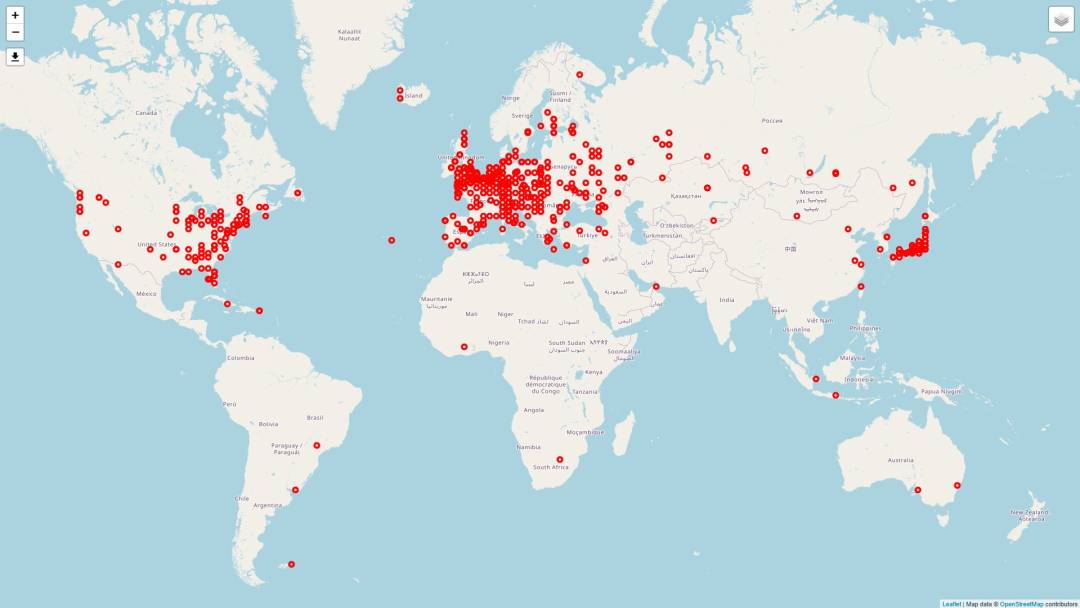
Plotted QSOS
-
Apr 16 2026; SF=105, A=4, K=1
Nice to see swallows in the yard for the first time this year. We first saw one about a mile away a week ago.
Pleased to find V85NPV on 17m CW this afternoon with a good signal. I've heard him on a few bands recently, but not made any headway in working him! It wasn't the easiest QSO this afternoon, but Didier pulled me out ok and that's a nice new country. I haven't worked Brunei often. I remember working it years ago as G4VXE when Nigel G3TXF went there and I'm sure a QSO or two with others, but that's about it.
My QRZ page says that I don't really do QSL cards which I don't. I get the odd card which I'm happy to reply to with a local postcard or something. One arrived today from F8IJV for a QSO on 10m FM about 3 years ago! Lovely note inside saying I was his only GW, so will sort that out in due course.
-
Apr 15 2026; SF=101, A=4, K=1
Conditions must have been a little better this morning as when I called Graeme VK5GG on 20m CW he could hear me. Not well, but well enough to swap reports and say a quick hello. Tuned down the band a bit and could hear ZL1HJ again, in conversation with a French station. ZL1HJ, interestingly, seemed a little weaker than yesterday, I heard him say he was beaming over the North Pole.
-
Apr 14 2026; SF=99, A=3, K=0
I must have been catching the band just right in the morning to hear the ZLs. This morning, just before we had to head out for our Welsh lesson, I heard ZL1HJ. I did try to give him a quick call around 0825z but perhaps fortunately, because we needed to go out, he didn't hear me.
By the afternoon, conditions certainly didn't seem that great, but as ever, it was nice to work Joe AI0Y from North Dakota on 17m. Things are bad if Joe's on 17! I often work him on 10 or 15m. V47EM was coming through on 15m, but decidedly weaker than yesterday.
-
Apr 13 2026; SF=99, A=8, K=1
It started off feeling like one of those mornings when no-one can hear you. I called Graeme VK5GG on 20m CW who didn't seem to be able to hear me at all today and then a couple of distant Russians who couldn't either. The morning was 'saved' by Drew VK3XU who was just down the band on 20 CW. We had a nice chat and I reminded him of his rhombic on 40m and the QSOs we used to have fairly soon after I was licensed.
-
Apr 12 2026; SF=93, A=12, K=2
Bit of a busy day! First thing we collected some bees and got those set up into their new hive behind the barn. After that it was PW VHF column morning - so nice to get that written and off to Don. We went to Lower Town for a walk in the afternoon, so it's 1530z and I haven't made a contact yet! A few minutes before I have to go out again.
From what I can see, HF conditions are poor again, with 10m all but silent - there's the odd weak PY about. This morning there seemed to be a little Es on 6m, with a few stations from France and Switzerland coming through.
-
Apr 11 2026; SF=94, A=18, K=4
Well, you know conditions aren't great when you tune across 15m at the weekend, with a contest going on and there's only one or two stations audible!
Back on 20m, there was more going on. Curiously, stations from E7 were very loud as were UA9s - and fairly little in between!
-
Apr 10 2026; SF=98, A=7, K=2
Solar flux at 98! That feels like it's the first time it's been under 100 in a long while. Maybe I'm wrong as until recently, I hadn't noted it each day - but it hasn't happened often.
Perhaps that will augur well for the Sporadic E season this year. Last year, in Practical Wireless, I explored the 'Old Wives' Tale' as Dave G4ASR called it, that high sunspot years were poor for Es. Yet, it felt to me that it was so. I thought back to, I think 1989, when we went to Porto Santo for 50MHz and 144MHz and operated as G4VXE/CT3 and it was a really tough Es year and it was around the peak of cycle 22. Since then, I've gently noticed a correlation. Last year, I asked Jim G3YLA about it and he felt that there was perhaps a 'loose correlation' on the basis that if there is a lot of solar disturbance, then Es struggles to form. Jim suggested that any day when the K was over 3 then the Es would struggle to form.
-
Apr 9 2026; SF=108, A=7, K=1
HF conditions haven't seen great today and also the bands have been noisy with strong winds affecting the overhead power lines.
Had a nice chat with Roger GW5NF on 80m. He reminded me that there is a CE0 expedition on at the moment. I ought to try and track them down. It's not a bad path from here. I remember my first QSO with Easter Island as G4VXE on 10m CW using an ex-CB aerial back in around 1983/1984.
-
Apr 8 2026; SF=109, A=9, K=2
Paul G4RRA messaged to say that he'd worked UT1FG/MM this morning but wasn't sure about the square. So far I've only seen one decode from Yuri, presumably by aircraft, so I'm not hopeful of a QSO at this point. On the other hand, it's a misty morning here, which can do wonders for tropo - so we'll see.
-
Apr 7 2026; SF=116, A=10, K=2
Didn't get to the shack until later on as a busy morning with visitors and work here. Both Paul G4RRA and Andy GW0KZG had kindly messaged to say that Yuri UT1FG/MM was in IO22 on 2m FT8. Yuri is apparently running 20W as his amplifier is not working. I saw a few isolated decodes from him during the morning but gave him a random call when I got to the shack and somewhat unbelievably, he came back! Even better, it turned out that he was just crossing into IO23, so a few minutes later, I was able to work him from there as well.
-
Apr 6 2026; SF=118, A=12, K=3
Well it's my birthday! I was saying to Brian WB4IT last night that I've been licensed for 43 years now (I just checked and my first day on the air was 16th Feb 1983). I think I find it even more fascinating than I did then....
It's interesting being able to monitor 2m and 6m FT8 at the same time, one of the best things I did last year! For example this morning, I noticed a quick meteor burst on 2m at 0925z of F8PKC (JN38) while over on 6m, at 0924:45z the same burst produced F1PBZ (JN26) and G7TQB (JO00). Tying the two bands together make it clear that the propagation for all the decodes was meteor scatter, but individually, I don't think I would have known, particularly for G7TQB - I'd have assumed aircraft scatter (which of course, it could still be, but it seems unlikely).
-
Apr 5 2026; SF=128, A=16, K=3
Storm Dave went through last night, so I'd dropped the 80/40/15m mast down. Winds were normal this morning, so I've put it back up again. Still on the smaller vertical for HF. VHF conditions have moved away to the east now.
There's an SP contest on HF which I don't feel enthused about, so just been turning around on 17m this morning - a couple of Russian special event calls as well as EA8A.
Interestingly, I put the 6m rig on the vertical today, thinking that there might be some early Es around and having the vertical on means you can listen in all directions. Didn't hear any Es, but around 1910z I copied PY5CC and PP5ZP, probably the only stations I've heard outside the UK on 6m all day.
17m pretty quiet this evening, so popped onto 20m CW and worked Brian WB4IT in Alabama followed by Sandro I7ALE.
-
Apr 4 2026; SF=136, A=49, K=3
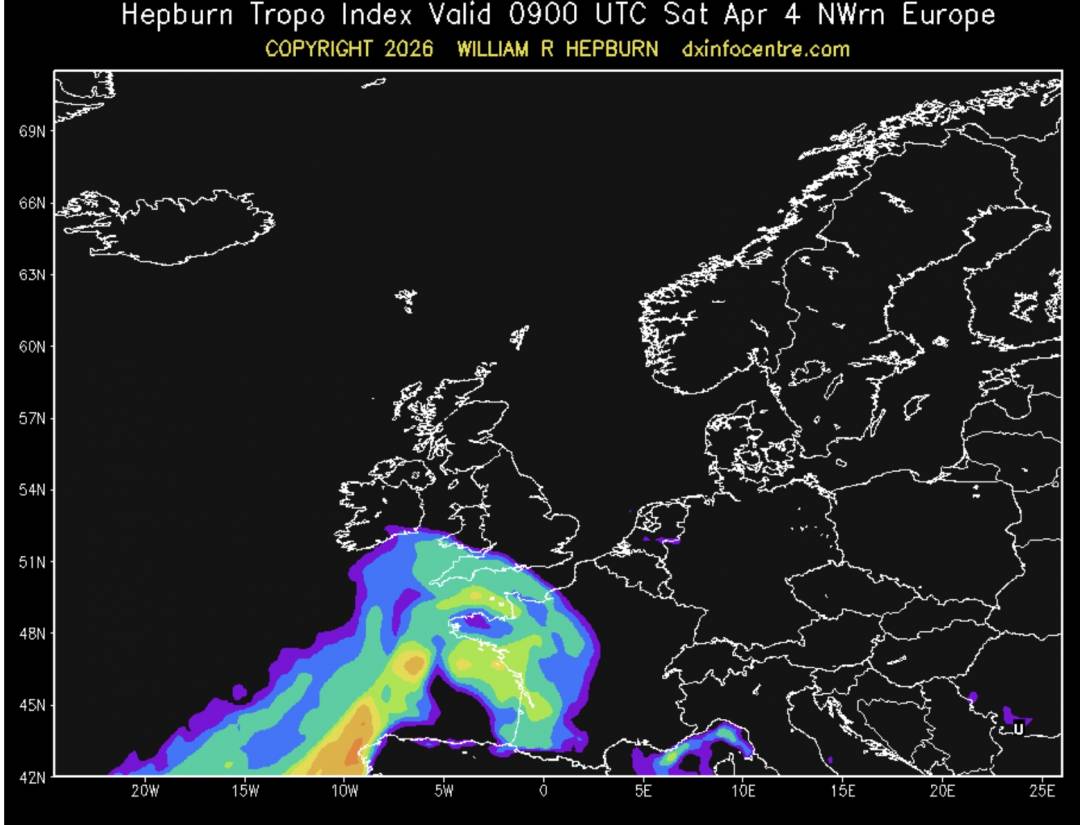
Checked 2m around 0625z as it had been good yesterday and sure enough CT9ACF was there, working G4KWQ. He seemed to go off pretty promptly after that QSO, so I didn't get a chance to call. Fortunately, by the time I'd showered and fed the chickens (and Duke the neighbour's horse), signals on 2m had improved and I was pleased to work Stevo. I wondered whether I might hear anything on 70cm and to my surprise, he was coming through there as well - so called him and was very pleased to work him - on the vertical of course.
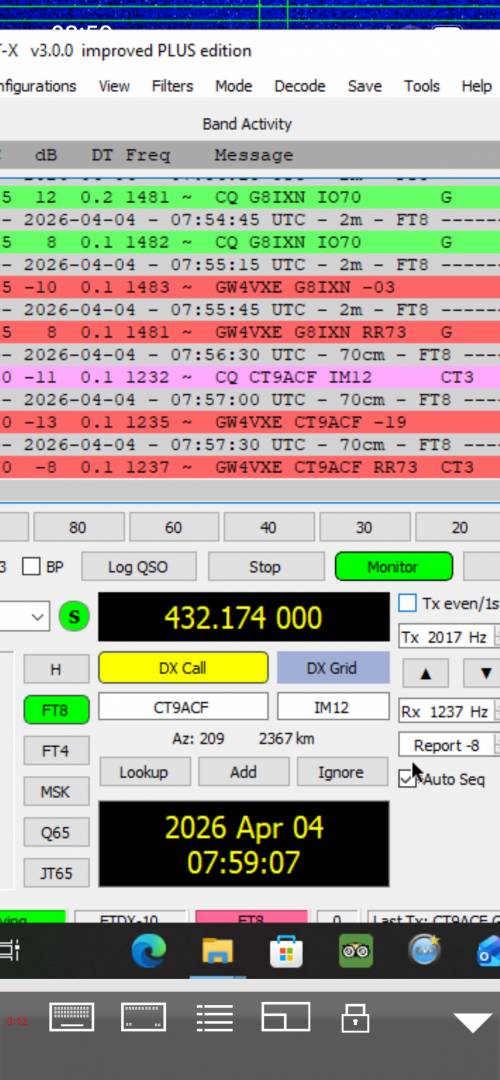
Not my best DX on 70cm (EA8 is about 500km further) but a welcome new country and one I was hoping to work.
Got back from the tip at around 1030z and saw EA8CSB calling CQ on 2m FT8. Not too strong, but I have a recollection that like me he uses a vertical. Gave him a call and he responded, but unfortunately signals faded and we couldn't complete the QSO.
Got back from tip run number 2 around 1200z and could see I'd received one or two loud decodes from EA8CSB on 2m while I'd been out. Tried a CQ down that way which he heard well, but probably wasn't in the shack. Popped over to 70cm for a CQ or two (no replies) but when I went back to 2m, EA8CSB was calling me at a steady -10, so this time we were able to complete the QSO without any problems.
According to the Hepburn forecast, the propagation will move away from me this afternoon - but it was a good morning.
By the afternoon, the VHF/UHF propagation was moving off to the East. Had a little play with the automatic FT8 app on 17m, but fairly unsuccessful (conditions not software!). Bands seemed poor in the evening - did work W1AW/4 from NC on 17m, but little else doing.
-
Apr 3 2026; SF=140, A=43, K=3
Some 2m propagation down to CT3 this morning - around 1000z - CT9ACF made it to around -15 here. On the vertical of course, so he would have been a great signal on a 'proper aerial'. I wasn't in the shack at the time otherwise could have probably worked him.
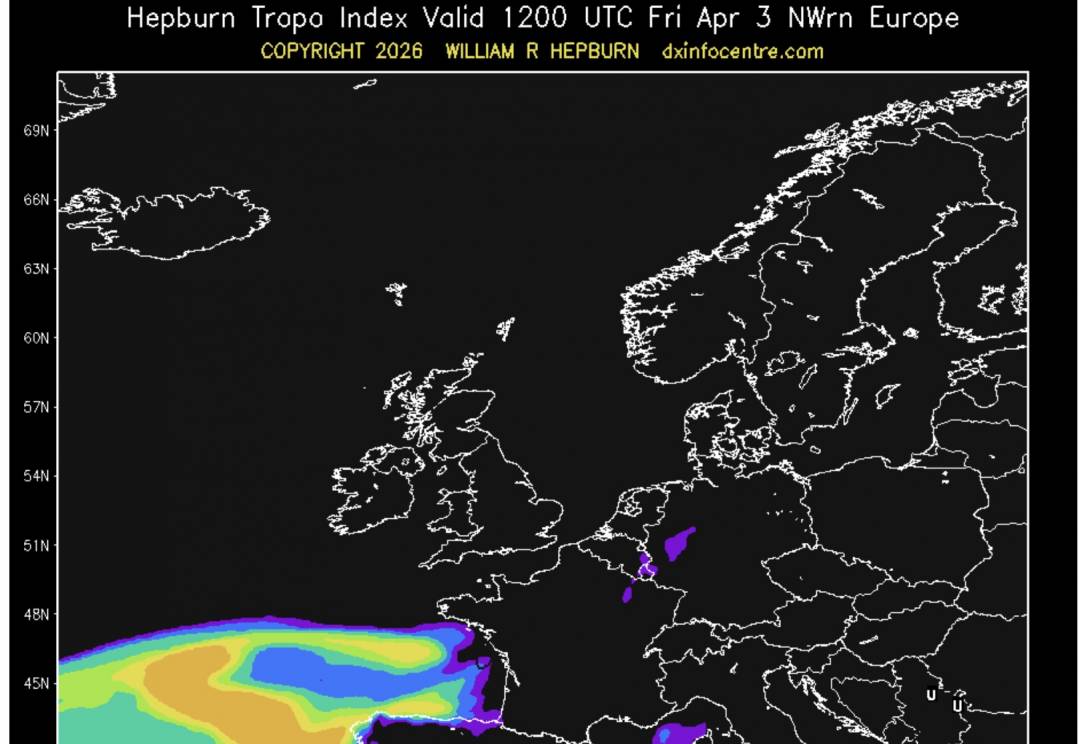
You can see that here, we're on the edge of the propagation, at the moment at least. Around 1400z, GM0HBK was visible for a couple of periods on 2m.
Other than that, a fair bit of testing with the automatic FT8 QSOs on 18MHz, running 100W (under close supervision!). The software did well only requiring a little manual intervention. Will I be doing lots of this? I don't think so, but it's fun to get going as well as possible.
-
Apr 2 2026; SF=142, A=8, K=4
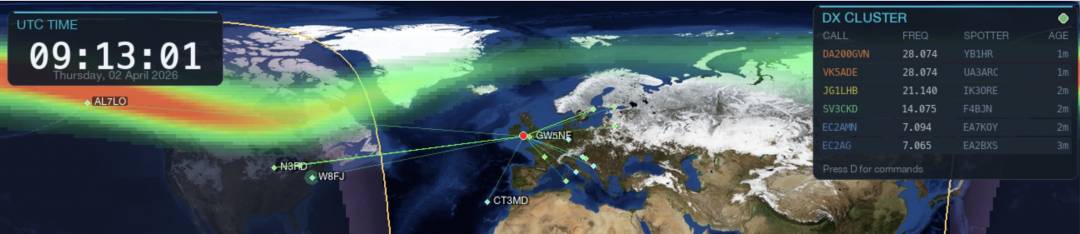
When you look at the solar data for the day and think....oh! I guess the transpolar paths may not be great today then.
Played a bit of HF FT8 as I was testing an interface that Pete MM9SQL is building between WSJT-X and Cloudlog. Looking useful so far. Nice to catch Rene DL2JRM operating as UT/DL2JRM which must be a new WAFOCC country.
A bit more semi-automatic FT8 operation on 17m in the evening - not sure I want to do a lot of this, but it's quite interesting to get going!
-
Apr 1 2026; SF=141, A=7, K=1
Started off looking for T31TTT on 12m FT8. No sign - but did find TT1GD which was a nice one - I thought it was a new country but after logging it, I noticed I'd worked TT8XX on 10/12m before.
Another QSO today with RI0SP up in the Arctic, this time on 17m CW. He had a very fluttery signal, perhaps not surprising where he is, up in the polar zone.
Bit of a play in the 13z CWT. Hard going to North America on 20 earlier on, but improved later and 15m too - although only really hearing the East Coast. Jim K6AR audible on 20m, but couldn't attract his attention this week.
Nice chat with Roger GW5NF on 80m SSB this afternoon. Missed the 19z CWT as went out for a bite to eat with a friend, but tried a CQ call on 17m when I got back and was really surprised to be called by Dave AL7LO in Anchorage, Alaska - a very easy and enjoyable QSO. I *think* I've only worked Alaska on satellite from here before - and then a nice chat with John W8FJ to close out the day.
-
DXChrono Desktop on the Raspberry Pi functional
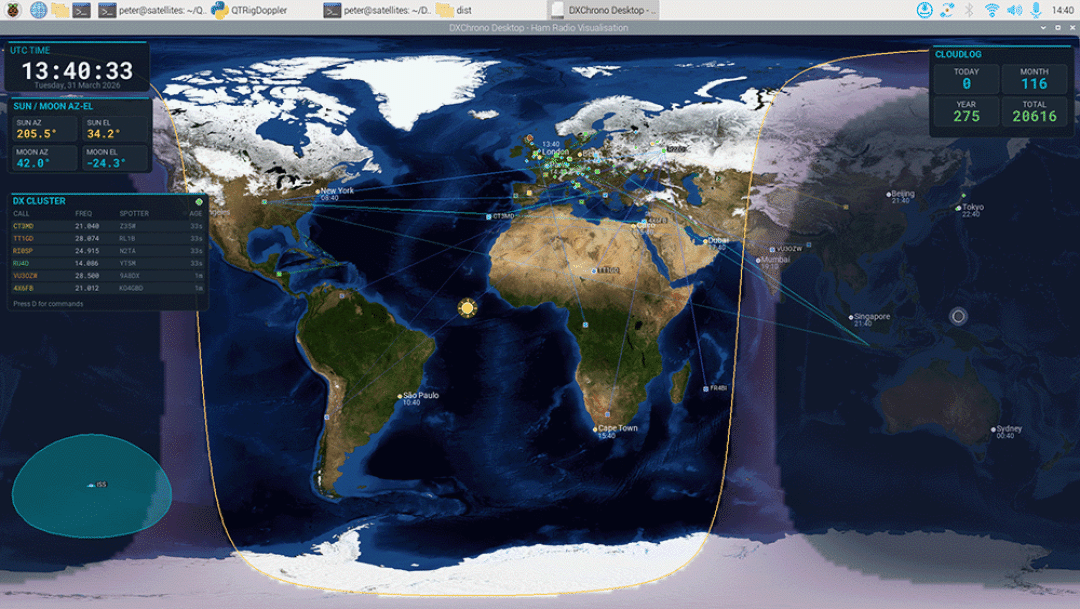
DX Chrono Desktop Running on Raspberry PI 5
I have been struggling a bit with Pygame on my Raspberry Pi 5 running Wayland, but last night I finally fixed the last couple of bugs, mostly related to the day/night terminator overlay and I have to say its working really well, currently running it in my shack and also on the shack tv at Charlie GM1TGYs so we shall test for a few days just to make sure its good before we start looking at public release