Cloudlog Station Diary Hub
Welcome, this is a hub for public Cloudlog station diary posts, gathered in one timeline so you can easily see what other stations are sharing.
-
Mar 31 2026; SF=152, A=12, K=2
Spotted S21WD on 10m FT8 as I got into the shack with 4 streams. Getting nowhere as I write this and will probably head outside and work on the strawberry bed in a moment. As it turned out, they stopped transmitting - so I dropped down on to 20m CW and had a quick chat with Willy LY2PX. Lots of fading - whereas Willy is normally a great signal on 20m in the morning.
So far, I haven't written very much about VHF/UHF activity here. I suppose that's because it's been very quiet on those bands here lately. I got into the shack after we replanted the strawberry bed this morning to find a screen full of CQs on 2m FT8 from GM0HBK up in IO77. This is not entirely unusual and happens a few times a year. It's a good path up the Irish Sea and towards the Western Isles. When conditions are good, I can work 'HBK using 50W to the vertical and we've made it on 70cm as well.
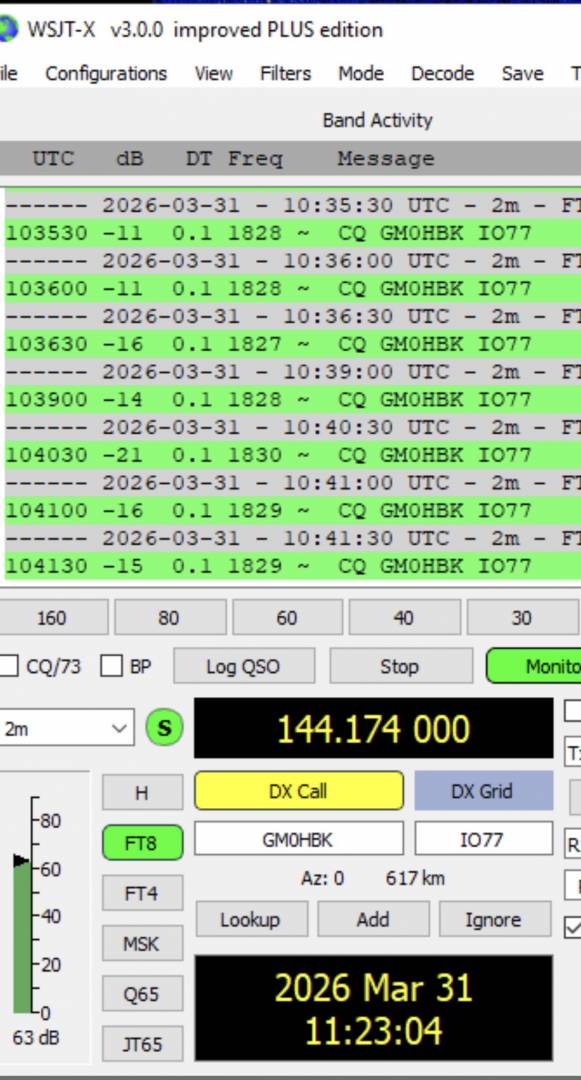
I tried a CQ when I got back to the shack and although it was well heard, it wasn't heard up in IO77! Nice to see some better propagation on 2m though.
A nice QSO on 10m around lunchtime was RI0SP who seems to be up in the Arctic somewhere! There's a picture of a polar bear on his QRZ page! I gather both CY0S and XX9W are QRT now. Pleased to catch Red DL1BUG operating as TY5FR on 12m CW this afternoon.
Ten metres brightened up what seemed to be a fairly poor day for DX in spite of a half decent solar flux; XQ6CF, PY1AX, CX5FK and HH2K in the late afternoon.
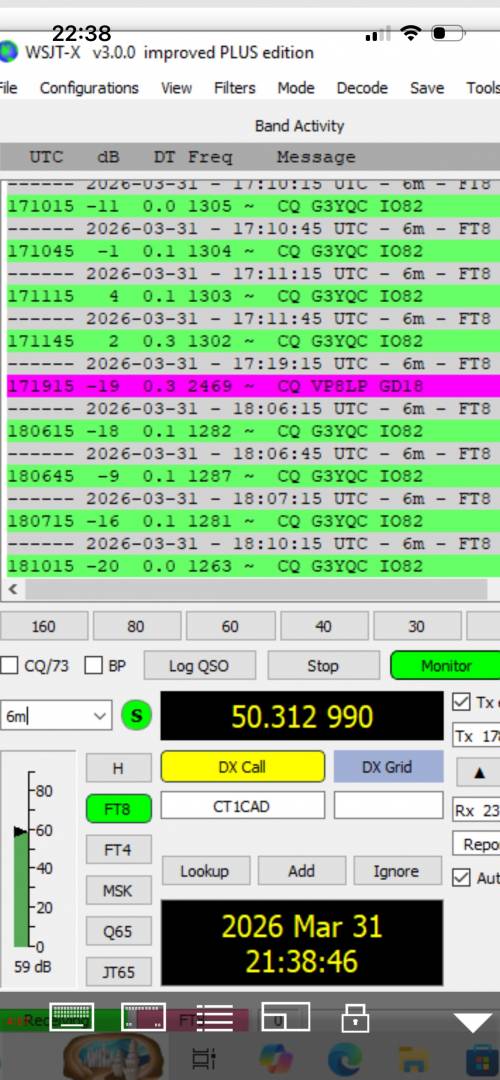
Popped out for the evening and when I got back, I was pretty amazed to see this on my 6m screen! Only one decode and I'm sure it wouldn't have been possible to make a QSO. Even so, it looks like I was the only person in the UK to receive VP8LP this evening. He had plenty of spots in Southern Europe as well as North America.
-
Mar 30 2026; SF=158, A=14, K=2
Pleased to find the noise on HF reduced this morning - it's still there, but not as bad as last night. The wind's dropped and it's not as damp, which probably helps. Bands seem pretty quiet this morning though - activity wise.
Got back from a few errands in Fishguard to find Pete MM9SQL had implemented a widget for Cloudlog to show if you are on the air and what frequency you're on. That's on my QRZ page now. Also a message from Ed at RadCom asking if I'd be interested in reviewing the new Moonraker Luna transceiver - the answer of course is yes! The rig's sold out, so it maybe a little while before I get one to have a look at. It looks similar to the TYT copy of the Yaesu FT-8800 although not identical - so I'm guessing it's from a similar but not identical stable..
Had a few calls to try and work Andy 5X2VJ on 10m CW and also S21WD on 20m FT8. Similarly no luck. Time for lunch!
I did catch Andy after lunch once the pileup had run down a bit. It was tough knowing where to call as the pileup was inaudible here. Spent a little time over lunch looking at the pictures from Nigel G3TXF and Ian G3WVG from their operation as 3B8XF and 3B8VV respectively. Looks nice!
Finished some work in the house and came up to the shack with a cuppa and was pleased to find new FOC member, Randy, K5ZD operating from V4 - I managed to sneak a QSO in just before he went QRT. I enjoy working SOTA and POTA portables and working portables from North America is a real thrill. Mike WB2FUV is a regular operator and I've worked him a good few times now. Had a QSO with Mike on 18MHz this afternoon - signals were really marginal today - but we managed to swap reports ok.
CY0S and S21WD expeditions busy on 20m CW after 2030z. Managed to work S21WD which I thought was a new country but apparently isn't! Also nice to catch VK2GR, not as loud as sometimes, but an easy QSO. CY0S had an operator change and Sean G3ESE had posted his QSX frequency on the cluster - tried there and they came back first call. Nice to get CY0 on 20m CW as well as FT8.
-
Cloudlog Dev Update – Widgets, DX Improvements & Lots of Polish
Been a fairly productive few days on the Cloudlog dev branch, mostly focused on performance, usability, and a few long-overdue features.
On Air Widgets (Finally)One of the nicer additions this week is a proper embeddable “on air” status.
There are now two options:
/widgets/on_air/YOURCALL → iframe-style widget/widgets/on_air_image/YOURCALL → SVG badgeThe SVG version is probably the most useful. It’s lightweight, updates automatically, and can be dropped into QRZ pages, blogs, or wherever.
It shows:
ON AIR / QRTFrequency + mode (or SAT if applicable)Also spent a bit of time making sure it behaves nicely:
Sensible caching (not too aggressive)Dynamic sizing so it doesn’t look awful with longer textProper sanitisation so nothing explodes in SVG landDX Highlighting – Much Smarter NowThis has been bugging me for a while.
Previously, Cloudlog would only highlight DX properly if the distance was already stored, which meant perfectly valid QSOs could get ignored.
That’s now fixed.
We now:
Fall back to gridsquares (and VUCC grids)Calculate the distance if it’s missingPick the actual furthest QSO rather than “first one that matches”Result: more accurate DX highlighting without relying on perfect data.
DX Cluster ImprovementsQuite a bit of work went into the cluster side, too.
UI & BehaviourStatus is now a proper badge (instead of boring text)Handles connection states better (connecting, reconnecting, etc.)Tooltips now actually make senseFilteringAdded mode filterAdded “New DXCC” filterImproved how spots are held until worked status is knownRBN FixesTightened up RBN detection so it stops misclassifying random spots as skimmers.
(That regex was… optimistic.)
Track BandNew option to track the radio band automatically, or turn it off if you prefer manual control.
DX Cluster in the QSO ScreenThis is probably the biggest user-facing change.
You can now enable a DX Cluster tab directly inside the QSO interface.
Live WebSocket feedClick a spot → fills the QSO formOptional auto-QSY to your radioIt basically removes the need to bounce between pages.
QSO Form – Faster & Less ChattyMoved a bunch of calculations client-side:
DistanceBearingLocator handlingThis removes a load of AJAX calls and makes the form feel much more responsive.
Same logic as before, just running in the browser now.
FT8 / FT4 + Band LogicUpdated frequency lists and tightened up band/mode detection.
Should now be a lot more accurate when Cloudlog tries to guess:
Mode from frequencyCorrect band segmentsParticularly noticeable on VHF/UHF and some of the edge cases.
General UI / QoLA mix of smaller improvements:
Pagination no longer resets every time the table redraws (finally…)Per-user control over QSO fields & tabsCleaner contest UI with statsBetter handling of manual mode inputFewer JS errors when things aren’t initialised properlyUnder the HoodBit of housekeeping too:
Centralised DXCC checks (less duplication)Removed some questionable direct $_GET usageReduced unnecessary redraws and DOM workGeneral performance tweaks across the boardFinal ThoughtsThis release isn’t about one big flashy feature — it’s more about:
Making things fasterMaking things more accurateAnd removing a bunch of small annoyancesThe dev branch is looking pretty solid now, so aiming to get this rolled into a stable release soon™.
More tweaks incoming as always.
-
Mar 29 2026; SF=162, A=10, K=3
Clocks went forward this morning and an early start owing to have to medicate Cedric the cockerel at 0815 meant I was in the shack early. Found FO/F6BCW on 20m CW but didn't seem to get anywhere with the pileup. T31TTT was on 20m FT8 coming through with about 6 streams. They came back about 2nd call which was very pleasing for a new country.
Bands didn't seem that exciting during the day. By the evening, there was a lot of noise on the bands (damp and the overhead power lines no doubt) but CY0S were strong enough to be heard on 17m and had a minimal pileup, so it was nice to work them on CW for a new band country.
Spent a little time playing with a nice radio control package called Wfview which talks to the TS-590SG. I'd hoped that it might work as a remote control package, but it seems their client/server setup only works for Icom radios at the moment. Looks promising for the future though.
-
Mar 28 2026; SF=162, A=9, K=1
BW QSO Party today - and Julie's birthday! So, I didn't plan too much activity as we were heading to Tenby.
Made a few QSOs in the morning and then a few on our return in the evening. particularly on 20m; VK7BO, VK2GR, TY5FR and Andy 5Z4VJ operating as 5X2VJ.
-
BARTG HF RTTY Contest
Last weekend saw the annual BARTG RTTY Contest. Like last year, I took part with Charlie GM1TGY operating as GM5G in the M/S High Power category, one radio. In the same category last year, we came #3, so I had some hope that we might have been able to improve on that, but it wasn't to be.
2 am Saturday, and on the shack's TV running DXChrono, I could see that the aurora was pretty much sitting on top of us. The result was that 80/40m was really slow going. I think most of the night we were on 80m.
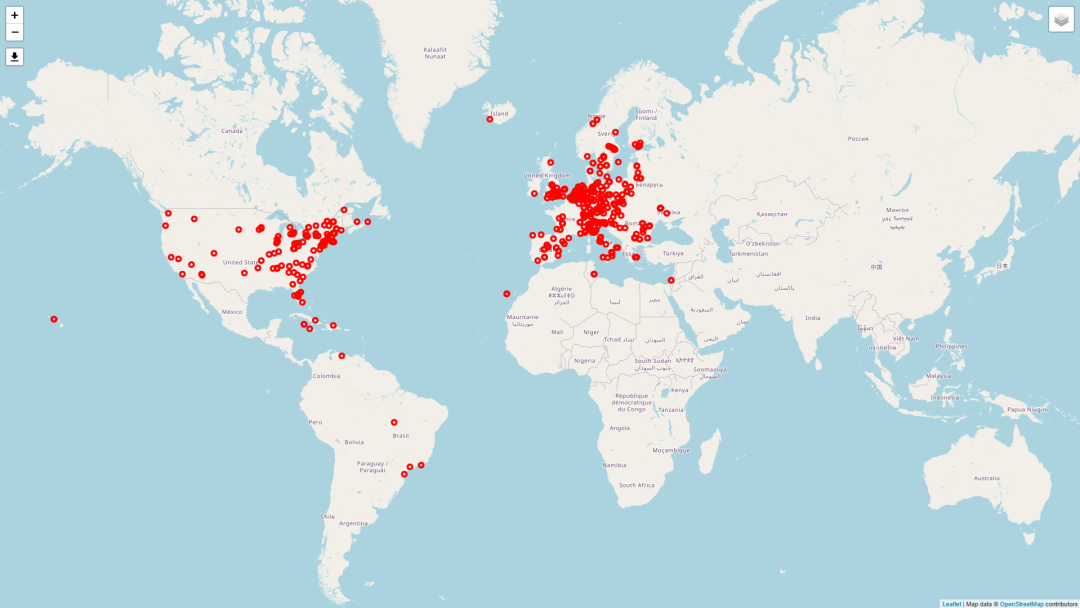
Plot of all the QSOs
We knew Saturday morning we would have to go QRT as we had just replaced the SPID RAK rotator that turns the EAntenna 59+. It was, for some reason, binding, so tower over. Found the issue: a jubilee clamp was getting caught, stopping full rotation (doh). So we made some modifications and got back on the air around 16:00z. I was optimistic that 15/10m would be open, but the aurora hadn't really shifted. Hence, I ended up sitting on 20m running with a very good rate, but as night drew in and the aurora conditions dived again.
In the end we had run out of people to work around 01:00z so decided to call it and get some sleep rather than work nothing however we was back on air before sunrise around 06:00z the rate however was slow and it was just a matter of jumping between 20/40m looking for QSOs when the rates dropped 15m opened up briefly on Sunday and on 10m I worked just 3V8LL.
As Sunday afternoon progressed, conditions worsened, with more auroral flutter and distorted signals, followed by periods of the bands just going totally dead with no signals to be seen. It stayed in this pattern up until the very end.
That said, the shack was working perfectly, using a Kenwood TS890S (FSK keying), Gemini 1200 amp and our usual selection of antennas
EAntenna 59+ (20-10m)2el Phase for 40m40m Dipole80m Quarter-wave Vertical80m DipoleK9AY for RXWe finished the contest early at midnight after running out of callers, spent over 40 minutes on 80m calling CQ to myself, but we ended up with 534 QSOs, not including Dupes.
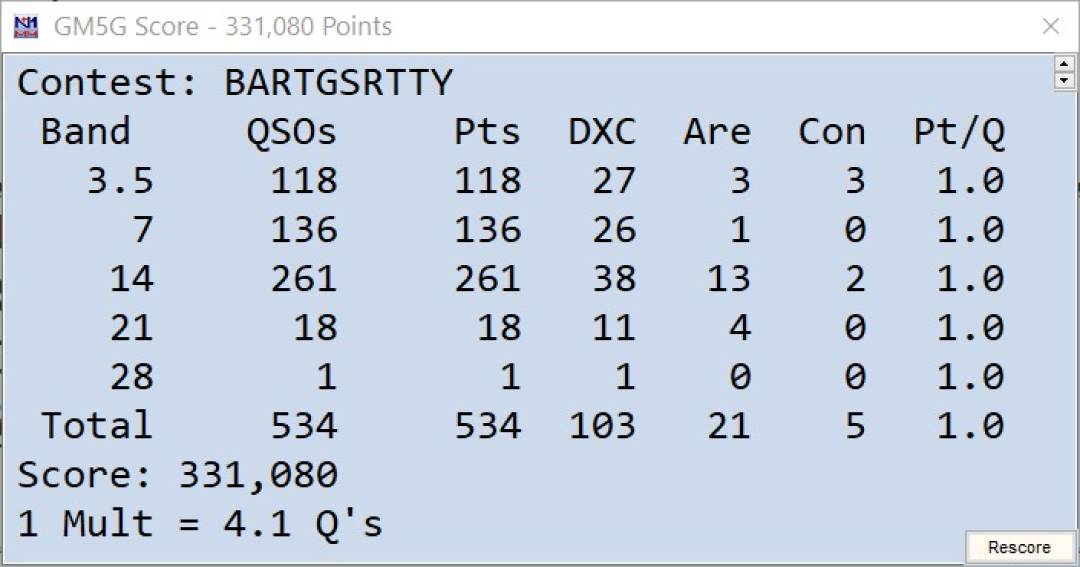
Contest Summary
Maybe next year will be better
-
Mar 27 2026; SF=152, A=10, K=1
Solar flux heading up today although conditions still don't seem that great, although we're probably starting to see seasonal decline kick in! Last year I pretty much abandoned HF except for SOTA chasing between April and September. Hoping it'll be a bit more interesting this year..
15m brightened up around 1330z, with contacts to FG/F5HRY, PJ7AA and AI0Y. Even caught 10m open to W5ZR in Louisiana around 1600z although the band was fading by then. Worked XQ6CF on 10m CW around sunset. Saw a DX spot that T31TTT were on 10m FT8. I could see their US pileup, but sadly, not them....
EX0T was a nice one on 10MHz around 1900z. Bob's DU7ET as well - always in interesting places.
-
Mar 26 2026; SF=140, A=17, K=1
Wind had dropped so I put the DX Commander Signature 9 back up.
Picked up CY0S on 10MHz CW and shortly after on 14MHz FT8 (new band country). More locally, nice to work Declan EI6FR/P out on the hills in Ireland,
I've heard XX9W on CW a bit this morning but not strong enough to have a go at. Unfortunately TX5EU went QRT while I was away, so I won't be working them :-)
Got home from Haverfordwest and Justin messaged to remind me about the 80m SSB contest. Worked him and about 4 others.
CY0S coming through well on 40m CW, but a few calls didn't work, so I gave up as I'd worked the slot already!
-
March 25 2026; SF=128, A=16, K=3
Last morning in Cheltenham. Had a tune around on 40m remotely but no DX heard this morning. Tried a CQ and was well heard around Europe, and worked ON3DEN. The 40 and 80m dipoles seemed ok after a stormy night, which was a relief. VK2IA quite loud on 20m but he was going to have his evening meal and I needed to head up the road to see Mum. Nice to hear VK2IA talking to Steph F5NZY about remote setups.
Popped onto GB3CG and had a chat with John G8CQX.
Got back home around 1300 and had a very quick tune around in the dying moments of the 13z CWT. Conditions seemed very poor, only heard one W on 15m. Made the last few minutes of the 19z CWT and just a handful of QSOs on 20m with little DX. Did hear Tom K7QA with a nice signal but didn't have a chance to call him.
Tried CY0S for a while around 2100z on 18MHz FT8, but they were working mostly Jas. Went onto 15m and was pleased to work Dani LU1JI for a bit of a chat and CX5FK. Code practice from W1AW was pretty loud, so the band was open to the US as well.
-
Mar 24 2026; SF=124, A=28, K=3
I don't often get the chance to listen on 40m fairly early. All was quiet until I got around 7.025 where I could hear VK2ARZ initially working a ZL1 (didn't get the full call as a loud DL started up just above the frequency). VK5PH, who was just audible then called VK2ARZ who said it was 'time for tucker'. Tried a quick call to VK2ARZ in the hope of a quick QSO, but no luck. Nice to hear though.
Tried a few CQs and although seemed to be well heard in EU on the RBN, no callers
Nice chat with Iain M0PCB and John G8CQX on GB3CG (which was acting up, rather crackly).
Visited John G8CQX in the afternoon which is always interesting and inspiring. We went through various antenna models including a look at how to make the 10MHz part of my short vertical work a bit better. It will be interesting to try it.
Pete MM9SQL mentioned WFVIEW as a possibility for remote controlling the TS-590SG. It looks an interesting option with some nice facilities so I'll have a look at that when I get home.
Something 'odd' happened on 15m with the dipole - the rig seemed to lock up. Absolutely fine on the vertical, so I'm guessing with the high winds at home, the dipole has got snagged on a bush or similar and I'm getting some RF which is locking things up.
Here in Cheltenham, I worked Pete G4IOA on 2m CW with the Quansheng. Finished with him, came back to the remote setup and heard him working Derek G3NKS on 80m. Had a nice chat with Derek and then Ini EA6EJ on 80m from home.
-
Mar 23 2026; SF=120, A=75, A=2
Had a bit of a listen on 20m first thing. TX5EU very weak to start with but by 0800z they were a decent signal, Didn't bother to call!
Had a chat on GB3CG with John G8CQX and then later went to the Breakfast meeting at 'The Aviator' at Gloucestershire Airport. Lots of CARA and Gloucester club members there - quite a big attendance this morning. Nice to see everyone.
-
Mar 22 2026; SF=107, A=44, K=5
Quick tune around first thing working a few Russian stations in their contest on 20m, Nothing more distant heard.
Here in Cheltenham, had a quick chat on GB3CG with Mike G4NVY and Ken G3LVP.
-
Mar 21 2026; SF=102, A=34, K=3
A few days of remote operating coming up.
Had a quick tune around on 20m and worked a few stations in a contest - no idea what it was, but it was just fun to work a few people on 20m and 40m. It's surprising who hears you running 100W and who doesn't....
Looks like the A index has shot up this evening.
-
Contest lead up
Surprisingly, I managed to get a few solid hours of sleep last night, which should mean I won't feel so shattered during the 2am start of the BARTG Contest on Saturday morning. This morning, I've been putting together contest cheat sheets that Charlie GM1TGY and I use at every event, which include a breakdown of the important rules and last year's results. I'm not keen on the forecast for Aurora activity over the next couple of nights; it could lead to very slow rates and fluttery signals. However, perhaps big antennas and plenty of power will save us.
-
Remote control with the TS-590SG
I’ve been playing with remote control of the station at home for CW. I’ve had FT8 capability for some years (using VNC software and before that, Teamviewer), but thought it would be fun to try CW. I started off looking at using the TS-590SG remotely as I knew Kenwood had freely available remote control software. I found that the rig control software worked well, but that the audio component was unreliable on some networks - here at home I couldn’t get the audio streaming to work IF the WiFi extender disk was on. If I switched if off, the client would work….if I switched it on the audio would vanish! Took me a while to figure that out! Fortunately, it would work if I tethered the remote PC to my iPhone - so that was what I used in Cheltenham last time I was there.
Dave VE3KG was interested in putting his ’new’ GW3AAA call on the air, so I said he’d be welcome to use my system remotely. We found that Dave couldn’t use the Kenwood audio software either. At that point, I installed DF3CB’s RemAud software (free) and that was a game changer. That just works - and it doesn’t just work for the Kenwood rig, it works for the FTDX-10 as well. So, although, the TS-590SG is better for remote operation as it has two antenna sockets which you can switch between, for LF and HF, I could use the FTDX-10 (controlled, say, by N1MM using a remote desktop session).
CW keying was an interesting challenge! In the TS-590SG remote software, you’ve got some memories and there’s also the ability to type into a buffer which it will send. Unfortunately, there’s no sidetone and you can’t see where it’s got to in the message that you’re sending. That’s usable for short QSOs, contests, even pileups, but it’s less good for rag chewing.
To give some more flexibility and a better experience, I’ve started to look at using Winkey (K1EL) hardware/software. You can run Winkey remote software to connect two Winkeys across the Internet, so the remote PC can have a Winkey with a paddle plugged into it, which will talk to a Winkey in the shack which will key the rig. And there’s sidetone at the remote end!
The other fun aspect of the whole thing is that for ‘my’ client, ie when I’m away from home, all the client side stuff is running on a Mac (albeit running a Windows virtual machine).
So, all in all, it’s been a great little project.
(This article was first published in the Cheltenham Amateur Radio Association newsletter, CARA News).
-
Mar 20 2026; SF=106, A=3, K=3
Had a fairly busy morning, so didn't get on the air until we went out to have sandwiches up on Dinas mountain. I took the little Quansheng UV-5K with the CW firmware installed, along with the micro paddle. A few CQs on both 144.050 and 144.300 but no luck on this occasion. It's a good take off from there, so it should have worked up and down the Welsh coast and across to Ireland. Perhaps next time!
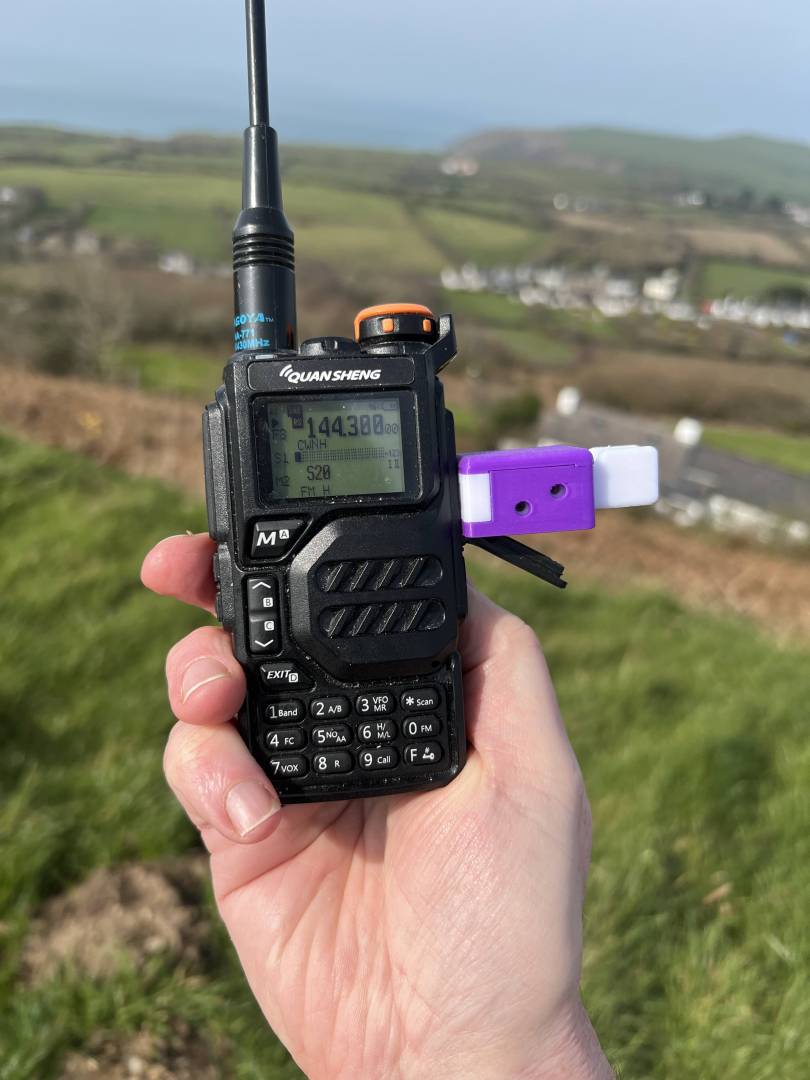
Back home and in the late afternoon, had a bit of a tune around 10 and 15m. Had a nice chat with Suad IT9/DK6XZ who I often work in the CWT sessions. I didn't realise but Suad remotes to Sicily from Germany and he was telling me that he had some latency with his remote audio - something I see on my remote system from time to time. Also worked W1AW/0 on 15m and Rich W3RJ on 10m.
Spent a little time checking that the remote to the TS-590SG as well as the FT-847 is all working as that will be in use over the next few days. When I operate remotely, I can only use 100W as I can't switch bands on the amps remotely. Checking it all out this evening, I was pleased to work XQ6CF on 20m, using 100W. That's sometimes a tricky QSO - so I was pleased when Wlad came back straightaway.
-
Thursday activity
It's been surprisingly nice weather in North East Scotland today, although it's only 13°C and we've had bright sunshine. I did, however, notice that hayfever season has started, but it made for a very pleasant walk around the village at lunchtime.
I didn't manage to get on the air until the afternoon when I spotted a Telegram message from Peter G0ABI saying he was doing a POTA on RS-44 in GB-4846. I worked him, plus a few others, then tried SO-50 just before dinner, working F4BFX for the very first time; it's always fun to work a new station.
-
Mar 19 2026; SF=113, A=5, K=0
The PC running WSJT-X for the FT-847 (2m) and FTDX-10 (HF) seemed to have got in a bit of a mess this morning and wouldn't talk to the FTDX-10. I think it was because I had a go at using WSJT-X Improved v3.1.0 the other evening to try FT2. Version 3.0.0 was confused because it didn't know about the last mode that was used, FT2. A reboot cured it (though going back into V3.1.0 and changing to FT8 might have done the trick too).
Is Super Fox and Hounds making a comeback? It does seem to be working better than when I first tried it a year or so ago. Anyway, CY0S seem to be using it and I was pleased to manage a 10MHz SFH QSO with them - satisfying as they were mostly working North America, although Dave G7RAU worked them the same time as me.
TX5EU coming through nicely on 20m CW at the same time too, but a big pileup and I can't really be bothered with all of that! Would be nice to work them on some band or mode!
Nice to find Ian G3WVG, operating as 3B8VV from Mauritius on 28MHz without too much of a pileup. Signals weren't strong although they seemed to be getting louder as it was around sunset in Mauritius.
The sked with Roger GW5NF was moved to today. Had a nice chat and then was called at the end by Roger GW3UEP in Ceredigion - another very pleasant QSO. When we finished, John GW4SRE called GW3UEP. I remembered John from Swindon days, so called in and had a quick chat. John is mostly on AM these days, with vintage gear.
Called CY0S on 20m SFH for a while but didn't get anywhere! It would have been a new band country I think. Tuned down the band and worked CO2OQ on CW running 5W and then WB0RLJ in Nebraska on a POTA trip.
-
Mid week already and only 1 QSO
It's been one of those weeks where you feel like you have been chasing your tail and not much is getting done; however, it has been reasonably productive. Work-wise, I have been trying to get a client's website finished, ready for launch at the end of March, but at the same time, I have been getting DX Chrono finalised
I've added a dedicated Special Event Station mode with custom features, added N1MM+ support so you can plot contest or DXPedition QSOs in real time, and fixed quite a few macOS bugs. Alongside that, I have been getting the website and documentation ready. I have decided to sell DXChrono Desktop for a one-off fee. I suspect some won't mind, and others will be livid that it's not open source and free, but it will help with the running contests of some of the background services and also helps me buy Molly pup more treats (She has an expensive jumper habit!).
Cloudlog-wise, not a huge amount has changed. Public Diaries have been well received, and today I fixed an issue with eQSL importing, as since I introduced batch importing to speed things up i broke a few things in the process, oops!
Thankfully managed 1 QSO RS-44 this evening, was hoping for some North America on this pass, but only heard two guys having a ragchew, also picked up 2 more on FO-29. However, I am looking forward to taking part in the BARTG RTTY Contest this weekend, especially after missing the ARRL DX SSB after ending up in the hospital.
-
Mar 18 2026, SF=111, A=4, K=1
Power interruption from 0930 to 1330 today, so not much radio planned until later!
Had a bit of a play in the 13z CWT as the power came back early. Conditions on the higher bands seemed poor - next to nothing on 15m. Nice to catch Jim K6AR on 20m though. Knowing Jim, that was probably long path! 15m brightened up in the late afternoon;AI5IN in Texas and Joe AI0Y in North Dakota.
Nice sunny day, so mostly outside doing mowing and strimming!
The 19z CWT was better than expected with some some west coast stations workable on 15m - curiously I seemed to be louder there than some of the US stations calling them. KH7X was around too, but in Arizona and not Hawaii! Another interesting QSO was with Adrian KO8SCA. I presume he's on the boat back from Bouvet so he'd have been remoting to his home station from the Southern Ocean.
Interesting to hear TX5EU on 15m around 2200z - they had a big US pileup, so didn't make any headway with that. Also CY0S opened up on 40m around the same time.
-
Mar 17 2026; SF=111, A=10, K=1
Propagation must be a little better this morning - the 10.101MHz RTTY was audible on the ATS-Mini.
Didn't get on to the air until I was back from Welsh in the afternoon. Conditions didn't seem great, but one or two interesting QSOs on the higher bands; FG/F5HRY on 24MHz, LB5SH/MM coming back from Bouvet to Cape Town on 28MHz.
I installed the latest WSJT-X Improved with FT2 mode added. Made a couple of QSOs, the first being J69DS. I don't really like the idea of FT2 as it throws away so much sensitivity, but the QSOs are certainly quick.
-
Cheap, cheerful but robust vertical for 10 - 28MHz
During the winter when the winds are high, I use a shorter vertical than the DX Commander Signature 9. Although the Signature 9 would probably cope - it flexes hugely and is anxiety inducing to watch in a storm. So, a couple of years ago, I decided to build an antenna which would cope with all but the worst winter storms.
I had a fibreglass pole which I could use and I decided to try running quarter wave lengths of wire up the outside of the pole, taping them on. I started off with quarter waves for 10, 15 and 17m. I used the lengths from the DX Commander User Guide on page 8 - I used the same lengths as on the Signature 9. Next, I added a wire for 20m and that too worked alright.
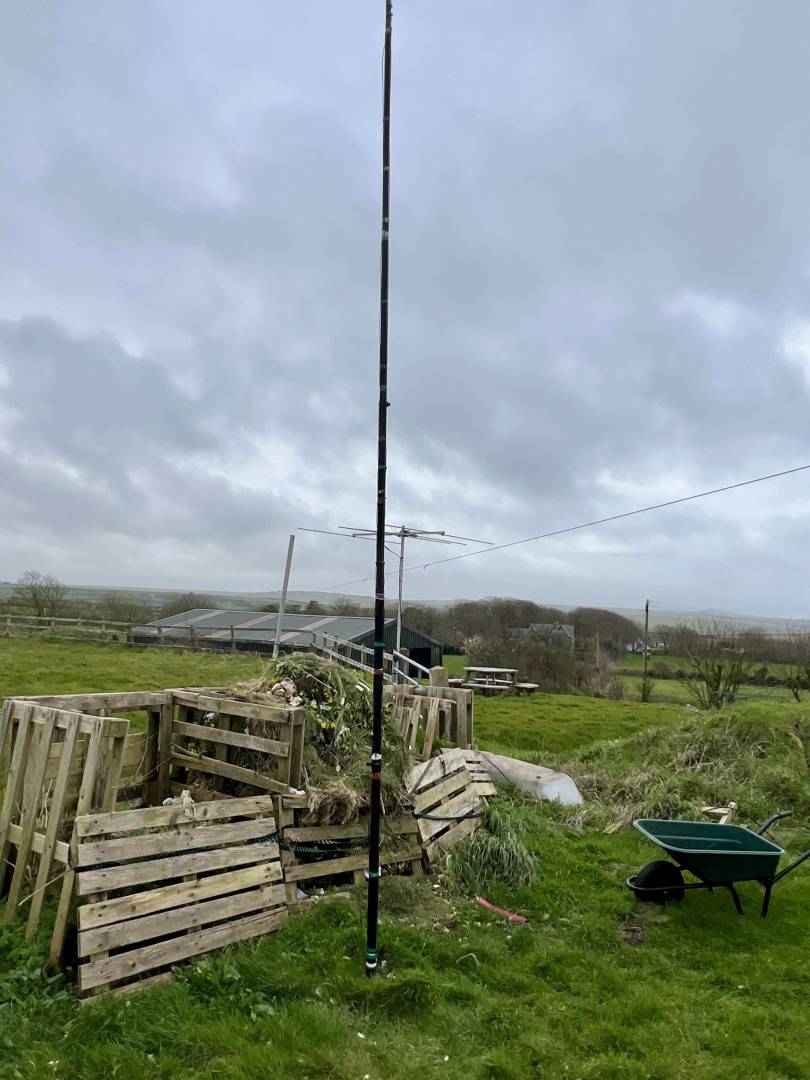
I wondered whether I could do something for 30m. as that's quite a useful band for working SOTA stations as well as DX! The element length for 30m was a bit long at around 7m and if I extended the pole to that length, it would start to be quite whippy in a high wind (which I didn't want as that was why I built the aerial in the first place!). So I decided to stick with the pole length of around 5m and run the 30m element back down the other side of the pole.
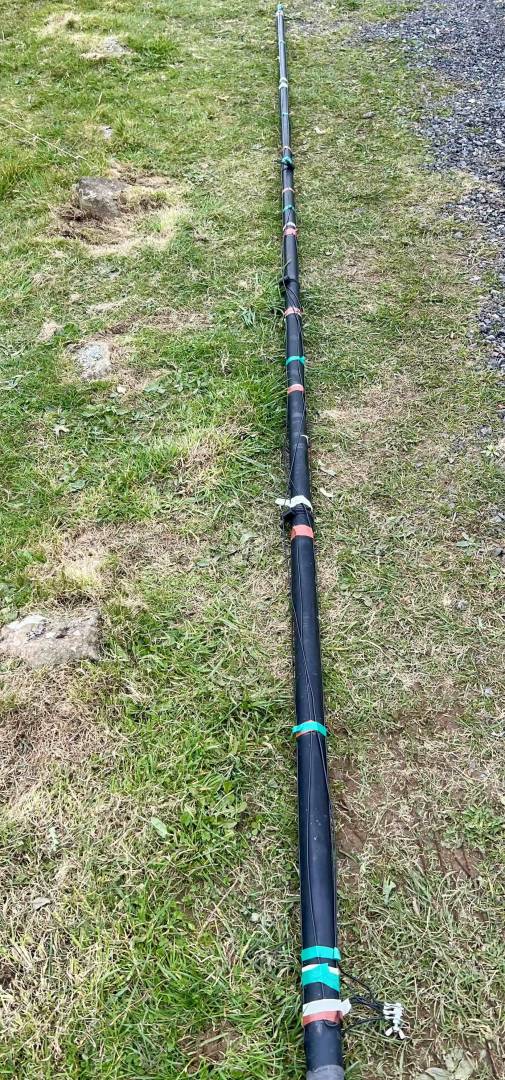
To my surprise this worked! The SWR is a little high at around 1.5:1 but it's quite useable. Does it radiate? It does! It's fine for semi-local QSOs around Europe and just recently I worked J51A with it. It does struggle on real DX contacts though, but it's better than nothing.
The only band I haven't mentioned is 12m. The curious thing is that one day I tried it to see what the SWR would be like and to my surprise it was ok and it's capable of working DX.
So, there are 5 lengths of wire on the pole. The pole uses plastic clips to stop the sections slipping down inside each other (DX Commander sell these). The wires are simply taped onto the pole. I crimped tags onto the ends of each element and clamp these onto to a bolt, where the feed can be attached. The pole sits on the same ground post as the DX Commander Signature 9 and uses the same set of radials.
I'm really pleased with how well this works and how it keeps me on the air in all but the worst of the winter storms.
I do want to credit Callum at DX Commander for the inspiration to build this really useful aerial. Thanks Callum!
-
Mar 16 2026; SF=109, A=17, K=3
Conditions definitely not great today - I checked the RTTY on 10101 on my little ATS-Mini around 0800 and it was barely audible! That's how bad it was.
Spent a little time revamping the 'storm' vertical as yesterday I'd spotted that one of the elements had become disconnected. I reworked the feed to clean it up and hopefully make it a bit more robust.
Conditions definitely poor! Spent a little while calling 3B8VV (G3WVG) on 15m for a while but didn't seem to get anywhere in the afternoon. Managed a few VE & W stations on 20m in the evening, but decidedly hard going. Worked PY1KO on 20m too, who was curiously fluttery - odd, given the path.
And another surprise - just before closing, I heard Darrel AA7FV on 18MHz CW. Darrel's in Arizona, so it was unusual that he was coming through, but there were practically no other signals on the band, apart from FT8.
-
Mar 15 2026, SF=112, A=40, K=2
Got on for the last 20 mins or so of the Commonwealth Contest - nice to work the usual VK suspects as well as Tony ZL2AGY. Conditions quite fluttery, although VL6T (VK6VZ) was strong with little flutter.
Bands seemed quite poor after we got back from a Mother's Day lunch up at Tafarn Sinc (car park very muddy and we got stuck and had to be pulled out!). 18MHz was interesting though and made a few nice QSOs including FG/F5HRY and then a nice chat with Peter W0SA in Minnesota. Peter's a retired doc from the Mayo Clinic and was running about 500W to a 43ft vertical.
Evening tune around was mostly on 20m. FH/UR9IDX was a bit weak and watery, but completed. Nice to work WB0RLJ from another POTA activation and Cathy W4CMG operating for the WWA-YL award.
-
Ten-Kon2 released into orbit
Ten-Koh2 was finally released into orbit today, so I have added that to the OscarWatch TLE set at https://tle.oscarwatch.org/amsattwolines.txt
Doppler.SQF line to save the endless asking, which will start soon as it's turned on
TEN-KOH2,435895,145915,USB,LSB,REV,0,0,SSB Transponder
I believe it's just in CW beacon mode for now, so we will have to be patient before we can make QSOs via it
Fairly quiet Wednesday for me, we had some stormy winds overnight but no antenna damage, managed to walk Molly pup around the village in the dry but its been pretty wet this afternoon.
Before lunch, I fixed a bug in Cloudlogs automatic satellite status reporting to AMSAT-Status since they recently changed all the naming, hopefully that won't need doing again. I think Cloudlog is almost stable enough for a release on Friday
RS-44 was quite lively at 14:30 I managed to work HZ1BL, 4L1AX, ER1KW which was a nice surprise, I always do far better working west than east from here.